
Africa’s Tongues: A Continent Silenced?
Introduction
Imagine a world where you couldn’t speak your mind freely, where your stories, your history, your very identity were slowly fading away. Now, imagine that happening not to you, but to entire communities, entire nations. This isn’t a dystopian fantasy; it’s a very real threat facing Africa’s linguistic landscape. We’re talking about the slow, agonizing decline of countless indigenous languages, and the question isn’t just about losing words, it’s about losing worlds.
More Than Just Words: The Silent Erosion of Culture
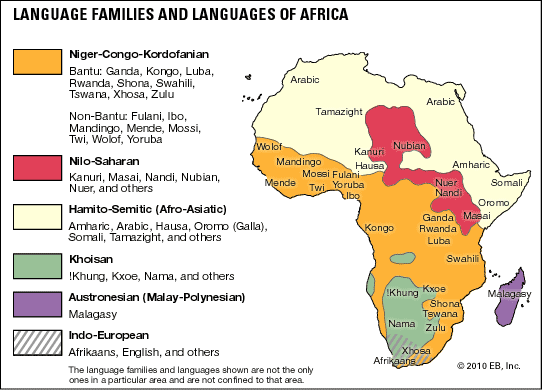
Africa, a continent of breathtaking diversity, boasts an estimated 2,000 languages. Each language is a unique vessel, carrying within it the traditions, knowledge, and cultural nuances of its speakers. From the melodic clicks of the Khoisan languages to the complex grammar of Swahili, these languages are the lifeblood of communities.
But this vibrant tapestry is unraveling. Factors like urbanization, globalization, and the dominance of colonial languages are pushing indigenous tongues to the brink of extinction. Let’s be clear: this isn’t simply a linguistic tragedy; it’s a cultural catastrophe with both immediate and long-lasting repercussions.
The Short-Term Pain: Disconnection and Disadvantage
In the short term, the loss of indigenous languages creates a chasm of disconnect. Children growing up in environments where their ancestral language is sidelined often struggle to connect with their elders, their traditions, and their cultural heritage. This can lead to a sense of rootlessness and identity confusion.
Furthermore, language acts as a barrier to accessing education, healthcare, and legal services. Imagine a rural farmer struggling to understand complex agricultural advice delivered in a foreign language, or a patient unable to accurately describe their symptoms to a doctor. These scenarios are commonplace, perpetuating cycles of poverty and inequality. In many African courtrooms, witnesses and defendants are forced to testify through interpreters, leading to misunderstandings and potential miscarriages of justice.
The Long-Term Scars: Erosion of Identity and Innovation
Looking further down the line, the consequences become even more profound. The loss of linguistic diversity hinders the preservation of indigenous knowledge systems – traditional medicine, agricultural practices, and environmental conservation techniques passed down through generations. These systems are often invaluable in addressing local challenges and promoting sustainable development.
Moreover, creativity and innovation suffer. Language is a tool for thought. When a language dies, a unique way of thinking, problem-solving, and expressing creativity vanishes with it. This loss of intellectual capital impacts not just the communities directly affected, but the world as a whole. Think of the lost potential of poets, storytellers, and innovators whose voices are silenced before they can even be heard.
Reclaiming Our Tongues: Practical Solutions for a Linguistic Renaissance
The good news is that it’s not too late. Reversing this trend requires a multi-pronged approach, focusing on education, technology, and community empowerment.
- Education is Key:The most crucial step is integrating indigenous languages into the education system. This means developing curricula that teach children to read and write in their mother tongues, alongside national or international languages. Imagine a school in rural Ghana where children learn to read Twi alongside English. This not only preserves the language but also improves overall academic performance, as students build a strong foundation in their native tongue before tackling a second language. Studies have shown that bilingual education programs significantly boost literacy rates and cognitive development.
- Harnessing the Power of Technology:Technology can play a transformative role in language preservation. We can leverage digital tools to create online dictionaries, language learning apps, and multimedia content in indigenous languages. For example, the development of mobile apps in Swahili, Hausa, and Yoruba are making it easier for young Africans to learn and use their languages in the digital age. Social media platforms can also be used to promote language use and cultural exchange.
- Empowering Communities:Ultimately, the success of any language preservation effort depends on the active involvement of the communities themselves. This means supporting local initiatives, creating platforms for language use in daily life, and promoting intergenerational transmission. Think of community-led workshops in Senegal where elders teach Wolof to younger generations through storytelling, songs, and traditional games. These initiatives foster a sense of pride in their linguistic heritage and ensure its survival.
- Policy and Recognition:Governments need to recognize and protect indigenous languages by enacting supportive policies. This includes funding language documentation and revitalization projects, promoting multilingualism in public services, and establishing language academies to standardize orthography and promote language development. South Africa’s constitution, which recognizes 11 official languages, provides a strong legal framework for language diversity and equality.
- Making it Cool:We need to shift the perception of indigenous languages from being seen as outdated or less prestigious to being vibrant and valuable. This can be achieved through cultural events, media campaigns, and the promotion of indigenous languages in popular culture. Think of contemporary African musicians who incorporate traditional languages into their songs, attracting younger audiences and celebrating their cultural heritage.
Choosing Your Path: A Variety of Approaches
There’s no one-size-fits-all solution to language preservation. The best approach will depend on the specific context, resources, and needs of each community. Here are a few alternative approaches to consider:
- Language Nests: Create immersive language environments where children are exposed to the language from a very young age, fostering fluency and cultural understanding.
- Mentorship Programs: Pair young people with fluent speakers to provide personalized language instruction and cultural guidance.
- Documentation Projects: Document endangered languages through audio and video recordings, creating a valuable resource for future generations.
A Future Filled with Voices: Taking Action Today
The silencing of Africa’s tongues is not an inevitable tragedy. By taking action today, we can create a future where these languages not only survive but thrive. This requires a collective effort, involving governments, communities, educators, and individuals.
Start by learning a few words in your ancestral language, supporting local language initiatives, or advocating for language rights in your community. Every small step contributes to a larger movement of linguistic revitalization.
The future of Africa’s languages is in our hands. Let’s choose to amplify these voices, celebrate their diversity, and ensure that they continue to resonate for generations to come. Let’s work together to create a world where every child has the opportunity to speak their mother tongue with pride, and where the rich tapestry of African languages continues to enrich the world. The time to act is now. Let the languages live!